

Suplas is an agricultural irrigation brand developed with the long-established engineering, production, and R&D experience of Akplas, operating in the sector since 1989.


Continuous planting in the same field increases disease pressure and reduces productivity. Leguminous crops and cereals, especially winter cereal groups, are ideal options for a proper crop rotation system.
Potato production uses tubers as seed material. Ideal seed tubers should be 6 cm in diameter and approximately 50 grams in weight. The seed variety should be selected according to the production purpose. Certified seed tubers that meet standards should be preferred. At planting, eyes should be awakened with green sprouts approximately 1 cm in length.
Row spacing ranges between 70–75 cm, while in-row spacing for tubers varies between 20–40 cm. Planting depth is 2 cm in shallow planting and 5 cm in deep planting. In shallow planting, ridging should cover the tubers with at least 15 cm of soil, while in deep planting 10 cm of soil ridging is sufficient. Ridging timing:
Potato requires regular care. Pre-emergence field combing with a spike-less rake helps break crust and suppress newly emerging weeds.
When seedlings reach 3–4 leaf stage, first hoeing is applied without harming the surface soil. The soil is aerated, weeds removed, and moisture preserved. This process can be repeated 3–4 times in 20-day intervals if necessary.
Potato responds well to organic manure. Yield visibly increases when applying 1.5–2 tons per decare, or 2.5–3 tons per decare in soils poor in organic matter. Exceeding these rates can negatively affect taste and starch balance.
The best practice is to determine fertilizer needs based on soil analysis prior to planting. If no analysis is done, 14–16 kg nitrogen, 8–10 kg phosphorus, and 8–10 kg potassium per decare is recommended for irrigated potato.
Phosphorus and potassium plus 50% of nitrogen (as ammonium sulfate or urea) should be evenly spread manually on planting lines and covered with soil. If a combined potato planter is used, phosphorus and potassium plus half nitrogen is applied on the same band with seed. The remaining 50% nitrogen is applied before first irrigation and earthing-up.
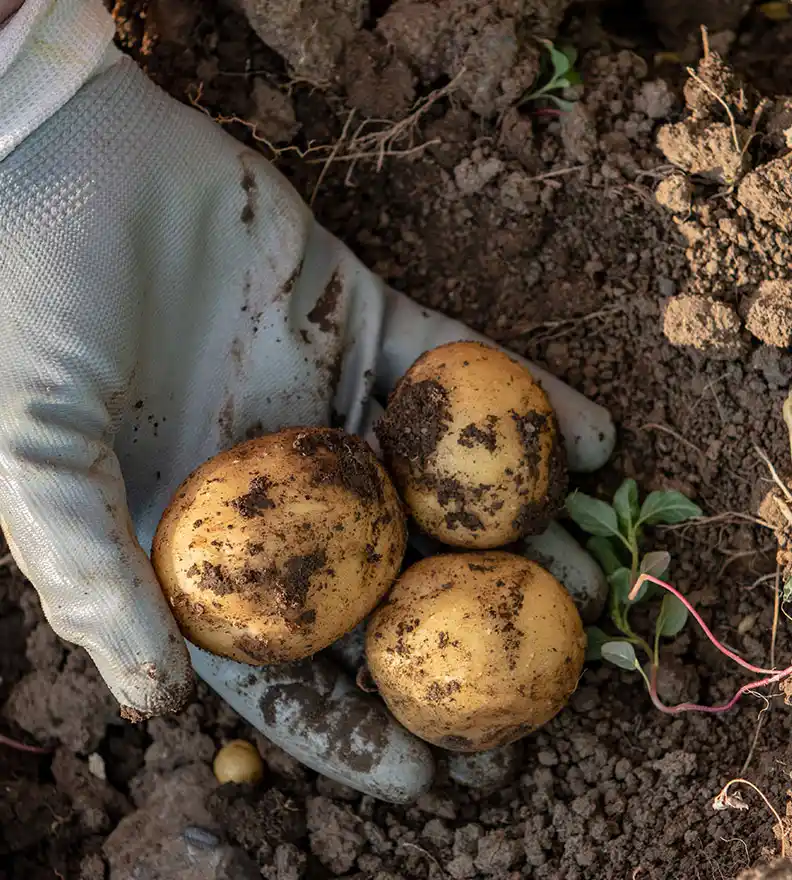
Harvest time is identified by natural drying of leaves and stems, full tuber sizing and hardened skin. The skin does not peel easily with a fingernail. The cut surface is dense and matte, not watery.
Care is essential during harvest. Tubers must not be damaged, and none should be left in the soil. The soil should be at ideal tilth, not too wet or too dry.
Harvest methods:
Harvesting and lifting can also be done with single or double row potato harvest machines.
If tubers are wet after harvest, they are kept in shade to dry. Diseased, rotten, and damaged tubers are discarded. Then, graded into large, medium, small and packed into net sacks.
Incorrect storage can lead to severe losses due to high water content. Rotting, shrinkage, sprouting and quality decline may occur.
Best storage conditions are: mature, undamaged, clean tubers stored in specialized facilities at 3–4oC temperature, 85–90% relative humidity, equipped with active ventilation to control CO₂, heat, respiration moisture and ensure oxygen flow. Pile height can reach 3–4 m for table potato, but must not exceed 1 m for seed tubers.
REFERENCES
Ahmet ERAKMAN Agricultural Engineer – SAMSUN
